How to Secure REST APIs OWASP Vulnerabilities (2026 Guide)

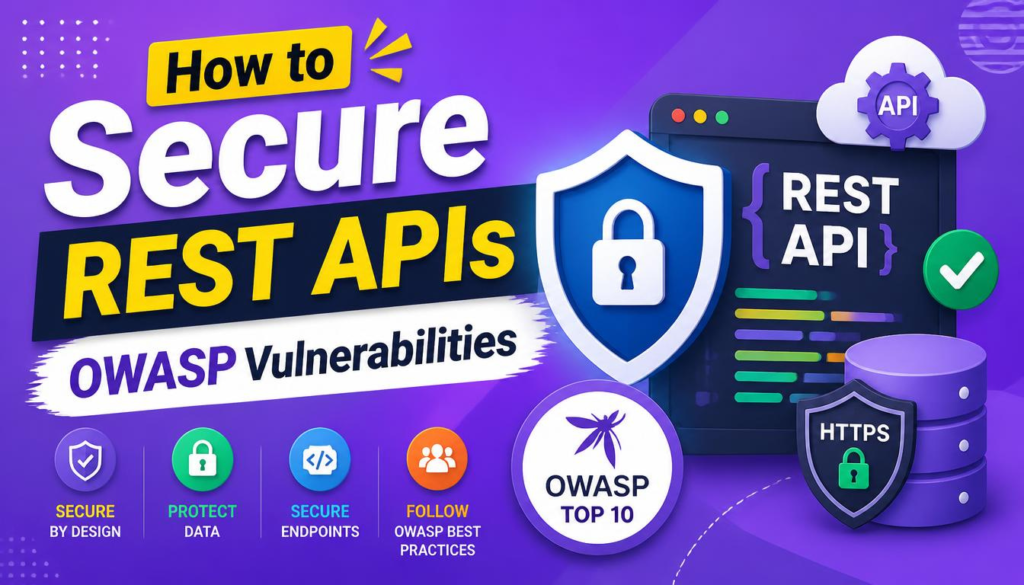
Let’s be honest for a second: REST APIs are the invisible machinery powering pretty much everything we build today. They quietly handle the handshakes between web apps, phone clients, payment systems like Stripe, and backend microservices. When they work right, nobody notices.
The downside? Because APIs sit right between public traffic and your sensitive core databases, they are essentially the front doors of your software infrastructure. And if that door is left unlocked, an attacker won’t just steal a password—they’ll dump your entire database, take over client accounts, or hijack your cloud servers. Learning how to secure rest apis owasp vulnerabilities is the single most important skill a modern backend developer can learn today.
If you want to know how to secure rest apis owasp vulnerabilities, simply dropping an authentication header on your API routes isn’t going to cut it. You need a solid, multi-layered defensive strategy that covers authorization logic, input sanitization, strict rate limits, and real-time monitoring.
In this practical, battle-tested developer guide, we’ll cut through the academic jargon and walk through real-world ways to understand how to secure rest apis owasp vulnerabilities before malicious actors exploit them in production.
Key Rule of Thumb: Authentication is just asking “Who are you?”. Authorization asks “Are you actually allowed to touch this specific row in the database?”. Mixing these two up is where 90% of security horror stories start.
Why API Security Kept Me Up at Night
Think about how a standard application stack is wired under the hood:
┌─────────────────────────────────────────────────────────────┐
│                   Typical API Architecture                   │
├─────────────┬─────────────────────┬─────────────┬───────────┤
│ Web / Mobile│  ──( HTTP Request )─>│ REST API    │ Database  │
│ Client App  │  <─( JSON Response )─│ Gateway     │ & Services│
└─────────────┴─────────────────────┴─────────────┴───────────┘
Your API routes give external HTTP requests direct access to high-value internal assets:
- Customer personal identities and contact logs
- Financial ledgers, invoices, and credit card tokens
- Private database keys and microservice configurations
- File storage buckets and admin action routes
When a developer forgets to sanitize a parameter or slips up on a permissions check, automated bot scripts will eventually spot it. Learning how to secure rest apis owasp vulnerabilities is what stands between a smooth release Friday and a stressful weekend incident response. Software engineers who understand how to secure rest apis owasp vulnerabilities build far more resilient production systems.
(Note: If you want to see how edge infrastructure blocks rogue web traffic before it hits your backend scripts, check out our guide on How Firewalls Protect Websites and APIs).
Understanding the OWASP API Security Framework
The Open Worldwide Application Security Project regularly aggregates breach reports to compile the official OWASP API Security Top 10 list. It’s basically a cheat sheet of the most common ways API engineers shoot themselves in the foot. When searching for how to secure rest apis owasp vulnerabilities, this framework is your starting blueprint.
┌─────────────────────────────────────────────────────────────┐
│               OWASP API Security Top 10 Risks               │
├─────────────────────────────────────────────────────────────┤
│ • Broken Object Level Authorization (BOLA)                  │
│ • Broken Authentication Mechanisms                          │
│ • Broken Object Property Level Authorization (Mass Assign)  │
│ • Unrestricted Resource Consumption (No Rate Limits)        │
│ • Broken Function Level Authorization                       │
│ • Server-Side Request Forgery (SSRF)                        │
│ • Security Misconfigurations & Missing Headers               │
└─────────────────────────────────────────────────────────────┘
Let’s walk through 15 actionable engineering steps showing how to secure rest apis owasp vulnerabilities in real-world codebases.
15 Practical Steps: How to Secure REST APIs OWASP Vulnerabilities
1. Fix Broken Object Level Authorization (BOLA)
BOLA is the undisputed king of API flaws. It happens when your server verifies who a user is, but completely forgets to check if they own the specific object they’re asking for in the URL parameter. Anyone researching how to secure rest apis owasp vulnerabilities must prioritize BOLA fixes above everything else.
- Vulnerable Endpoint:
GET /api/users/123/orders - The Reality: User
888logs in, changes the number123in their browser tab to124, and instantly sees someone else’s order history and home address.
The Fix: Always validate resource ownership at the SQL/Database query level (e.g., WHERE order_id = :id AND user_id = :current_user). Also, stop using sequential IDs (1, 2, 3) for sensitive routes—switch to unpredictable UUIDs (/api/orders/e2a1-42bc...).
2. Lock Down Your Authentication Flow
If your authentication logic is weak or predictable, attackers will brute-force their way through your login routes using automated credential dumps. Understanding how to secure rest apis owasp vulnerabilities requires robust token management.
Best Practices:
- Stick to standard OAuth 2.0 flows and issue short-lived JWT tokens.
- Store JWTs in
HttpOnly,Secure,SameSite=Strictbrowser cookies—never drop them into plainlocalStoragewhere XSS scripts can scrape them. - Force token revocation mechanisms for logged-out users.
3. Block Mass Assignment (Object Property Authorization)
Even if users can only edit their own accounts, what happens when they send extra payload fields that your backend framework automatically maps to your database model? Mastering how to secure rest apis owasp vulnerabilities means locking down these hidden properties.
- The Attack: A user sends a
PATCH /api/user/profilerequest with a sneaky extra JSON property:{"name": "Alex", "isAdmin": true}.
The Fix: Never bind raw HTTP request payloads directly to database models. Use strict DTOs (Data Transfer Objects) or input validation schemas to whitelist only safe fields like displayName or bio.
4. Put a Lid on Resource Consumption (Rate Limiting)
An unthrottled API endpoint is an open invitation for DDoS attacks, database lockups, and massive server bills. Knowing how to secure rest apis owasp vulnerabilities means keeping a tight leash on inbound request rates.
┌─────────────────────────────────────────────────────────────┐
│                 Rate Limiting Control Layer                 │
├─────────────────────────────────────────────────────────────┤
│ Client Requests ──> [ Rate Limiter Gateway ] ──> API Server │
│                     (60 Requests / Minute)                   │
└─────────────────────────────────────────────────────────────┘
The Fix: Implement rate limit gateways (like Nginx, Redis, or Cloudflare) per IP or user account. Throttle heavy CPU endpoints—like /api/login or PDF generation routes—far more aggressively than static GET requests.
5. Protect High-Impact Business Actions
Certain API routes do dangerous things: transferring money, wiping data, changing emails, or granting elevated admin access. Knowing how to secure rest apis owasp vulnerabilities demands extra authorization checks here.
- Force re-authentication (a password prompt or MFA code) before executing sensitive actions.
- Log every administrative execution with accurate timestamps, IP tracking, and user context.
6. Defend Against Server-Side Request Forgery (SSRF)
SSRF happens when an API route accepts a URL from the user and fetches it from the backend server without validation. Attackers use this to trick your server into probing internal IP spaces or cloud metadata endpoints ([http://169.254.169.254](http://169.254.169.254)). Developers studying how to secure rest apis owasp vulnerabilities must sandbox all outbound requests.
- If your API must make outbound requests (e.g., webhooks), strictly whitelist allowed target domain names.
- Never let your API fetch raw internal IP ranges (
10.0.0.0/8,127.0.0.1).
7. Clean Up Security Misconfigurations
Leaving default configuration files, active debuggers, or unneeded endpoints turned on in production is like leaving the keys in your car’s ignition. Eliminating misconfigurations is a core rule when learning how to secure rest apis owasp vulnerabilities.
Pre-Deployment Checklist:
- Turn off framework debug modes and verbose error stack traces in production environment variables.
- Delete unused staging endpoints, test routes, and outdated documentation.
- Enforce security headers like
X-Content-Type-Options: nosniff.
8. Stop Running “Shadow” and “Zombie” APIs
It’s easy to build a quick /v1/ endpoint, release /v2/ a year later, and forget the old one is still online—unmonitored and using outdated logic. Proper inventory control is crucial for anyone studying how to secure rest apis owasp vulnerabilities.
- Keep an active catalog of every live endpoint, its version, and who owns it.
- Safely deprecate and shut down legacy endpoints as soon as client applications migrate.
9. Validate Incoming Data & Sanitize Output
Never trust data coming from a client device. Ever. A huge part of learning how to secure rest apis owasp vulnerabilities is treating all client input as potentially malicious.
- Enforce strict type checks, string length limits, and format regexes on incoming JSON.
- Always use parameterized SQL queries or secure ORMs to completely prevent SQL Injection (SQLi).
10. Don’t Over-Expose Sensitive Data
A common mistake frontend developers make is asking the backend for a full database object and letting JavaScript filter what gets displayed on screen. An essential strategy when discovering how to secure rest apis owasp vulnerabilities is stripping sensitive JSON fields server-side.
- Filter database objects on the server before sending JSON payloads over the wire.
- Strip out password hashes, internal system IDs, social security numbers, and internal flags from API responses.
11. Stop Over-Permissive CORS Settings
Cross-Origin Resource Sharing (CORS) tells browsers which websites are allowed to read your API responses. Setting wildcards on credentialed routes defeats the purpose.
- Never set
Access-Control-Allow-Origin: *alongsideAccess-Control-Allow-Credentials: true. - Explicitly whitelist your exact frontend domain names (e.g.,
[https://app.yourdomain.com](https://app.yourdomain.com)).
12. Enforce HTTPS Across Every Endpoint
Unencrypted HTTP traffic sends plain-text API tokens and user payloads over public Wi-Fi networks for anyone with a packet sniffer to intercept. Encrypting traffic is fundamental to how to secure rest apis owasp vulnerabilities.
- Enforce TLS 1.3 across all public API domains.
- Set HTTP Strict Transport Security (HSTS) headers to force browsers into encrypted connections automatically.
13. Write Clean Error Messages
When something breaks on your backend, your server should log the deep technical stack trace internally, but return a polite, generic response to the user. Sanitizing error messages is a key step in how to secure rest apis owasp vulnerabilities.
- Insecure Response:
"Database Error: Syntax error near 'SELECT * FROM users' in /var/www/api/db.js line 42" - Secure Response:
{"status": 500, "message": "An unexpected server error occurred."}
14. Keep an Eye on API Activity Logs
If an attacker is attempting a credential-stuffing attack on your endpoints, you need to know while it’s happening, not three weeks after your database gets leaked. Centralized logging helps you figure out how to secure rest apis owasp vulnerabilities during active attacks.
- Log failed login attempts, unexpected privilege escalations, and permission denies.
- Important: Always scrub sensitive user passwords, private keys, and credit card numbers from your application log files.
15. Test Your API Endpoints Continuously
Security isn’t a “set it and forget it” setting. You need to continuously test how your endpoints behave when someone intentionally feeds them malformed data. Automated testing guarantees you know how to secure rest apis owasp vulnerabilities over long-term software updates.
- Run automated static code analysis (SAST) and dependency scanners in your CI/CD pipeline.
- Regularly perform manual permission checks to ensure User A can never access User B’s resources.
Technical REST API Security Matrix
| Security Layer | Attack Vector | Primary Engineering Defense |
|---|---|---|
| Authorization | BOLA / BFLA Flaws | Server-side user permission checks on every database ID |
| Authentication | Broken Auth / Identity Theft | OAuth 2.0, short-lived JWTs, and secure HttpOnly cookies |
| Data Integrity | Mass Assignment / Data Leaks | Strict DTO schemas, output filtering, and field whitelisting |
| Traffic Control | DDoS / Resource Exhaustion | Rate limiting, IP throttling, and request size caps |
| Transport Protocol | Interception & MitM Attacks | Mandatory HTTPS (TLS 1.3) and strict HSTS policies |
Final Thoughts
At the end of the day, securing your application interfaces comes down to a single mindset shift: never trust client-side data. Assume every request hitting your server has been manipulated until proven otherwise.
When you take the time to properly authorize every object, sanitize every input field, and restrict payload exposure, knowing how to secure rest apis owasp vulnerabilities becomes second nature—and your backend infrastructure stays rock-solid as a result. By continually evaluating how to secure rest apis owasp vulnerabilities, software teams build safe and trusted modern web platforms.
Frequently Asked Questions (FAQs)
What is the most dangerous OWASP API security vulnerability?
Broken Object Level Authorization (BOLA) continues to cause the most real-world data leaks. It happens whenever a server trusts a client-supplied object ID without verifying if the requesting user actually owns that database record. Understanding BOLA is essential when learning how to secure rest apis owasp vulnerabilities.
Is using an API Gateway enough to keep my endpoints secure?
Not by itself. An API Gateway is great for centralized rate limiting, TLS termination, and basic IP blocking, but it cannot handle your core application logic, object-level database permissions, or custom business rules.
How often should my engineering team test for API vulnerabilities?
Automated vulnerability scanning should run continuously inside your CI/CD build pipeline, while manual penetration testing and permission audits should happen before major release cycles. Knowing how to secure rest apis owasp vulnerabilities requires continuous development integration.
What’s Your Stack Setup?
What’s been the trickiest part for your team when working out how to secure rest apis owasp vulnerabilities in production—getting granular authorization logic right, configuring strict CORS rules, or tuning rate limits without hurting legitimate users? Drop your thoughts or questions in the comments below!