Cybersecurity Career Roadmap 2026: How to Get Hired (No Experience Needed)

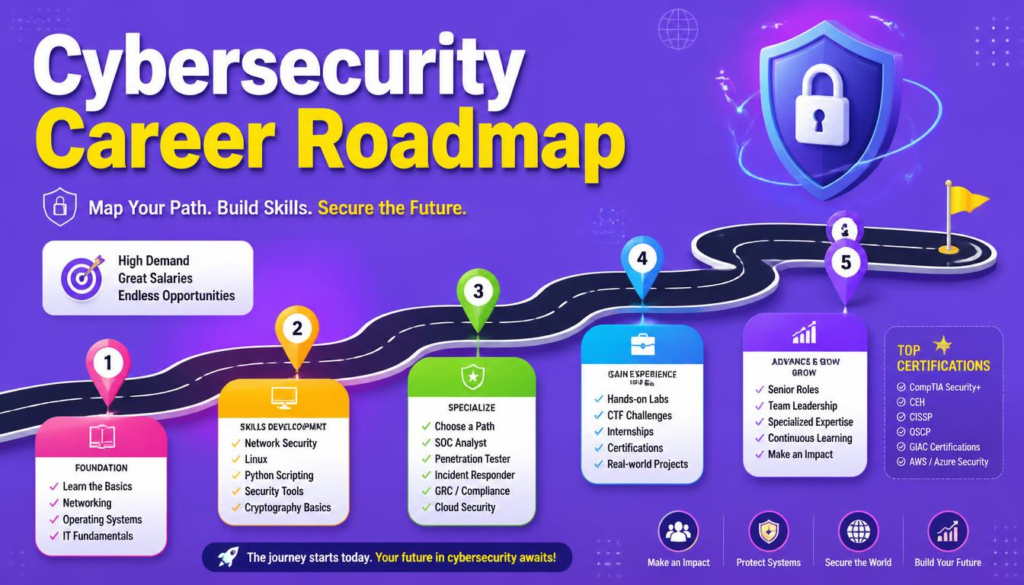
Let’s be honest with each other for a minute: looking at job boards today can be completely spirit-crushing. You open LinkedIn, find a role titled “Junior Cybersecurity Analyst,” scroll down to the requirements, and instantly see a laundry list demanding 3–5 years of experience, three high-level certifications, mastery over five cloud platforms, and expertise in tools you’ve never even heard of. Following a clear cybersecurity career roadmap 2026 is the smartest way to bypass this confusion.
It makes you want to close your laptop and ask: How on earth is a beginner supposed to get “experience” if nobody is willing to hire them without it?
I’ve been there, and I hear this frustration from aspiring tech professionals every single week. But here is the plain truth that HR job descriptions won’t tell you: cybersecurity is not a locked vault. You don’t need a four-year computer science degree, and you certainly don’t need to be a math genius or a master hacker straight out of a Hollywood movie. Anyone following a well-structured cybersecurity career roadmap 2026 can build the right skills.
What you actually need is a sensible, step-by-step game plan, a few practical skills you can prove on paper, and the confidence to show up and say, “I know how this works, and here is what I’ve built.” This cybersecurity career roadmap 2026 was built specifically to guide you through that process.
The modern NIST NICE Cybersecurity Workforce Framework backs this up—focusing heavily on what you can actually do in a workplace rather than how many textbook definitions you’ve memorized.
This cybersecurity career roadmap 2026 is the realistic, zero-fluff blueprint I wish someone had handed me when I first started exploring this industry.
Real-World Reality Check: Hiring managers aren’t looking for unicorns who know everything. They are looking for curious, reliable problem-solvers who can look at an unusual system alert, figure out what went wrong, and clearly explain how to fix it.
What Does a Real Cybersecurity Job Actually Look Like?
When people hear “cybersecurity,” they usually picture someone sitting in a dark room with green code falling down a black screen. In reality, the field is massive, diverse, and has a seat for almost every personality type. A good cybersecurity career roadmap 2026 helps you identify which domain matches your strengths:
┌─────────────────────────────────────────────────────────────┐
│                 Cybersecurity Career Domains                │
├──────────────────────────────┬──────────────────────────────┤
│ • Security Operations (SOC)  │ • Cloud Security             │
│ • Incident Response          │ • Application Security       │
│ • Vulnerability Management   │ • Identity & Access (IAM)    │
│ • Digital Forensics          │ • Governance, Risk & Compliance│
│ • Security Engineering       │ • Threat Intelligence        │
└──────────────────────────────┴──────────────────────────────┘
The biggest mistake I see beginners make is trying to swallow this whole chart at once. You don’t need to know how to perform digital forensics and write secure cloud code and audit legal compliance frameworks. Understanding this layout is a core step in your cybersecurity career roadmap 2026.
Pick one door to open first. You can always explore the rest of the house later.
11 Steps: The Cybersecurity Career Roadmap 2026
Step 1: Learn How Computers Actually Talk (Before Trying to Guard Them)
Imagine trying to become an auto mechanic without ever opening a car hood to see how an engine runs. That’s what skipping IT fundamentals looks like. A huge pillar of this cybersecurity career roadmap 2026 is building a solid base before jumping into fancy security tools.
Get Friendly with Basic Networking
You don’t need to become a network architect overnight, but you must understand the basics of digital traffic:
- IP Addresses & Subnets: How devices find each other on a local network vs. the internet.
- Core Protocols: What actually happens when your browser sends a request via DNS, HTTP/HTTPS, or TCP/UDP.
- Ports & Firewalls: Understanding ports like
80(HTTP),443(HTTPS), and22(SSH)—and how firewalls decide what gets through.
Stop Being Scared of the Command Line
Get comfortable moving around in both Windows and Linux environments without clicking your mouse. Learn how to:
- Manage user accounts and file access permissions.
- Check active processes and view live system logs.
- Use basic terminal commands to troubleshoot network connections.
If you are just getting started with terminal commands as part of your cybersecurity career roadmap 2026, check out our guide on Linux Commands Every Cybersecurity Beginner Should Know.
Step 2: Master the Fundamental “Rules of Engagement”
Once you know how networks communicate, it’s time to understand how security teams protect them. Every cybersecurity career roadmap 2026 emphasizes this core foundation:
┌─────────────────────────────────────────────────────────────┐
│                   The CIA Triad Core Model                   │
├──────────────────────────────┬──────────────────────────────┤
│ Confidentiality              │ Keeping private data private │
│ Integrity                    │ Preventing unauthorized edits│
│ Availability                 │ Ensuring systems stay online │
└──────────────────────────────┴──────────────────────────────┘
You’ll also want to etch this simple distinction into your mind—because interviewers love asking about it:
- Authentication: Proving who you are (like typing your password and entering a 2FA code).
- Authorization: Deciding what you are allowed to touch (like preventing a regular employee from opening HR salary spreadsheets).
Step 3: Choose Your Initial Career Track
To make steady progress on your cybersecurity career roadmap 2026, pick a direction that matches your natural strengths and interests:
- Security Operations Center (SOC): You’re the digital security guard. You spend your day monitoring dashboards, reviewing suspicious login alerts, and catching threats in real-time.
- Vulnerability Management: You’re the inspector. You scan company systems to find missing updates or weak configurations before bad actors find them.
- Governance, Risk & Compliance (GRC): You’re the strategist. You work with company policies, legal guidelines, and risk assessments. This path is fantastic if you love writing, analyzing, and communicating clearly.
- Cloud Security: You’re the architect. You focus on securing virtual infrastructure across AWS, Microsoft Azure, or Google Cloud.
- Application Security (DevSecOps): You’re the builder’s guardian. You work alongside software developers to test code and fix vulnerabilities inside application pipelines.
Step 4: Stop Just Reading—Start Building Hands-On Labs
Reading books and watching YouTube tutorials will only get you so far. When you step into a job interview, employers want to hear about what you’ve actually done with your own keyboard. Every effective cybersecurity career roadmap 2026 pushes for hands-on execution.
┌─────────────────────────────────────────────────────────────┐
│                 Typical Lab Setup Workflow                  │
├──────────────────────────────┬──────────────────────────────┤
│ Host Machine (Your Laptop)   │ VirtualBox / VMware          │
│                              │  ├── Ubuntu / Kali Linux     │
│                              │  └── Windows Server          │
│                              │  └── Splunk / Elastic SIEM   │
└──────────────────────────────┴──────────────────────────────┘
Here’s a simple project you can build on your laptop this weekend for free:
- Download VirtualBox (it’s 100% free).
- Set up a Linux Virtual Machine (like Ubuntu).
- Install a free SIEM log engine like Splunk or Elasticsearch.
- Intentionally generate some bad login attempts, watch how the logs appear in your dashboard, and write down what you observed.
Step 5: Package Your Labs into a Clean Portfolio
You don’t need a flashy custom website. A simple, well-written GitHub repository or a clean blog on Notion/LinkedIn is worth ten times more than saying “I completed an online course.” Building a portfolio is a major milestone in your cybersecurity career roadmap 2026.
What a Great Portfolio Project Looks Like:
- Title: How I Investigated a Brute-Force SSH Attack in My Home Lab
- The Problem: Explain what scenario you set up.
- The Investigation: Show screenshots of the log entries and queries you ran.
- The Finding: Explain what IP address conducted the attack and how many attempts failed.
- The Fix: Show the firewall rule or config change you implemented to stop it.
This simple layout instantly proves to a hiring team that you possess practical workplace skills.
Step 6: Pick One Real, Recognized Certification
Let’s clear up a huge myth: you do not need a mountain of certificates to get hired. In fact, collecting ten basic certs with zero hands-on projects makes hiring managers suspicious.
┌─────────────────────────────────────────────────────────────┐
│               Certification Progression Path                │
├──────────────────────────────┴──────────────────────────────┤
│ IT Foundations (Network+) ──> Security Core (Security+)     │
│                           ──> Hands-On Practice (BTL1/CySA+)│
└──────────────────────────────┴──────────────────────────────┘
For beginners navigating a cybersecurity career roadmap 2026, the industry standard baseline remains the CompTIA Security+ certification. It opens doors with recruiters and checks the compliance box for many government and corporate junior roles.
Get the cert, put it on your resume, and move straight back to building hands-on skills.
Step 7: Train the Most Underrated Security Skill: Communication
Here’s something tech bootcamps rarely tell you: cybersecurity is mostly a people business. The human element is an essential aspect of any cybersecurity career roadmap 2026.
If you discover a critical vulnerability, but you can’t explain why it matters to a non-technical manager in simple English, that vulnerability won’t get fixed.
- Practice writing short, jargon-free summaries of technical problems.
- Learn to explain risks in terms of business impact (“If we don’t patch this server, customer checkout will go down” vs “CVE-2026-XXXX is present”).
- Be the kind of person people actually enjoy working with during a stressful incident response.
Step 8: Write a Resume That Shows Action, Not Just Blah-Blah
Stop listing generic duty statements on your resume. Hiring managers skim hundreds of applications a day—give them concrete evidence of capability as outlined in your cybersecurity career roadmap 2026.
| Avoid This Boring Line | Write This Action-Oriented Result |
| “Studied network security and firewalls.” | “Configured and audited local UFW firewall policies on a Linux test server, successfully blocking unauthorized port access and documenting results in a lab report.” |
| “Learned about log monitoring tools.” | “Deployed Splunk SIEM in a home lab to ingest Windows Event Logs, creating custom search queries to flag suspicious PowerShell execution attempts.” |
Step 9: Aim for Realistic Starting Positions
Your very first security job might not have “Cybersecurity Specialist” as the title—and that is completely fine! Some of the best security engineers started in adjacent roles where they built real-world experience:
- Junior SOC Analyst (Tier 1): Monitoring alerts and escalating incidents.
- IT Support / Desktop Support: Troubleshooting real user systems, active directory permissions, and network drops (an incredible stepping stone!).
- Junior Vulnerability Analyst: Running scans and helping system admins organize patch schedules.
- Junior GRC Analyst: Assisting with policy documentation and vendor questionnaires.
Step 10: Humanize Your Interview Answers
When you land an interview, remember that the team sitting across the table isn’t just testing your technical memory—they want to see how you think under pressure. Showing that you followed a practical cybersecurity career roadmap 2026 gives you great stories to tell.
When they ask a scenario question like “How would you handle a user who clicked a suspicious email attachment?”, walk them through your thought process out loud:
- Containment: First, isolate the machine from the network so it can’t spread.
- Investigation: Look at the active processes and network connections to see what executed.
- Remediation: Clean the system or re-image it from a clean backup.
- Learning: Update the email security filters and educate the user calmly without making them feel silly.
Step 11: Follow a Realistic 6-Month Action Plan
Don’t burn yourself out trying to do everything in three weeks. Executing a successful cybersecurity career roadmap 2026 is about small, daily steps:
| Month | Focus Area | What You’re Building |
| Month 1 | IT & Networking Basics | Learn how DNS, IP, subnets, and CLI work. |
| Month 2 | OS & Security Fundamentals | Get comfortable with Linux, Windows admin, and CIA triad concepts. |
| Month 3 | Choose Your Domain | Select your focus path (SOC, GRC, Cloud) and start focused learning. |
| Month 4 | Build Hands-On Labs | Set up VirtualBox, install a SIEM, and analyze real traffic logs. |
| Month 5 | Portfolio & Certification | Write up 2-3 lab reports on GitHub and sit for CompTIA Security+. |
| Month 6 | Resume & Applications | Refine your resume, network on LinkedIn, and start applying consistently. |
4 Beginner Traps You Must Avoid
- The Cert Collector Trap: Spending $2,000 on five entry-level certifications while having zero hands-on lab projects to show for it.
- Skipping the Basics: Trying to learn advanced ethical hacking tools like Metasploit before understanding basic IP networking.
- The “Too Good for Support” Trap: Turning down a good IT Helpdesk role. IT Support is one of the fastest, most reliable gateways into a real security team.
- Isolating Yourself: Trying to learn everything alone in your room. A complete cybersecurity career roadmap 2026 involves engaging with local meetups, Discord security communities, and LinkedIn networks.
Your 2026 Career Readiness Checklist
[ ] Networking: I understand IP addresses, DNS, HTTP, ports, and subnets.
[ ] Operating Systems: I can comfortably navigate the Linux & Windows command line.
[ ] Security Basics: I can explain authentication, authorization, encryption, and risk.
[ ] Focus Path: I’ve chosen my initial domain (SOC, Cloud, GRC, or AppSec).
[ ] Hands-On Practice: I have built a virtual lab on my computer.
[ ] Portfolio: I have documented at least 2 real lab projects on GitHub or a blog.
[ ] Certification: I’ve prepped for or passed a foundational cert (like Security+).
[ ] Resume: My resume shows real action bullets and practical lab outcomes.
[ ] Mindset: I’m ready to keep learning every single day after I get hired.
Final Thoughts
You don’t need permission from anyone to start your journey today. The tools are free, the documentation is open to everyone, and the industry is actively looking for enthusiastic people who are willing to roll up their sleeves and do the work. By sticking to this cybersecurity career roadmap 2026, you set yourself up for long-term career growth.
Stick to the plan outlined in this cybersecurity career roadmap 2026: Learn the foundations → Pick a direction → Build real projects → Document your work → Show up with confidence.
Don’t wait until you feel like an “expert”—nobody in tech feels like an expert all the time. Following this cybersecurity career roadmap 2026 step by step will build your confidence day by day. Build something small today, write down what you learned, and keep moving forward.
Frequently Asked Questions (FAQs)
Can I really get hired in cybersecurity with no formal experience?
Yes, absolutely. Following a cybersecurity career roadmap 2026 ensures you gather alternative proof of capability through home lab projects, IT support background, or documented hands-on work.
Do I need to know how to code to work in cybersecurity?
Not for every role! Starting roles like Tier 1 SOC Analyst or Junior GRC Analyst require very little coding. However, as outlined in our cybersecurity career roadmap 2026, learning basic Python or Bash scripting down the road will make your daily work much easier.
How long will it take me to land my first job?
If you can dedicate 10–15 hours a week of focused study and hands-on lab practice while following this cybersecurity career roadmap 2026, most consistent beginners become job-ready within 6 to 9 months.
Where Are You Starting Your Journey?
Which domain in this cybersecurity career roadmap 2026 sounds like the best fit for your personality—investigating threats in a SOC, securing cloud setups, or working with policies in GRC?
Drop your thoughts or questions in the comments section below! If you found this roadmap helpful, pass it along to a friend who is trying to break into tech this year!




One Comment