Data Warehouse vs Data Lake vs Data Lakehouse: Best 2026 Guide!

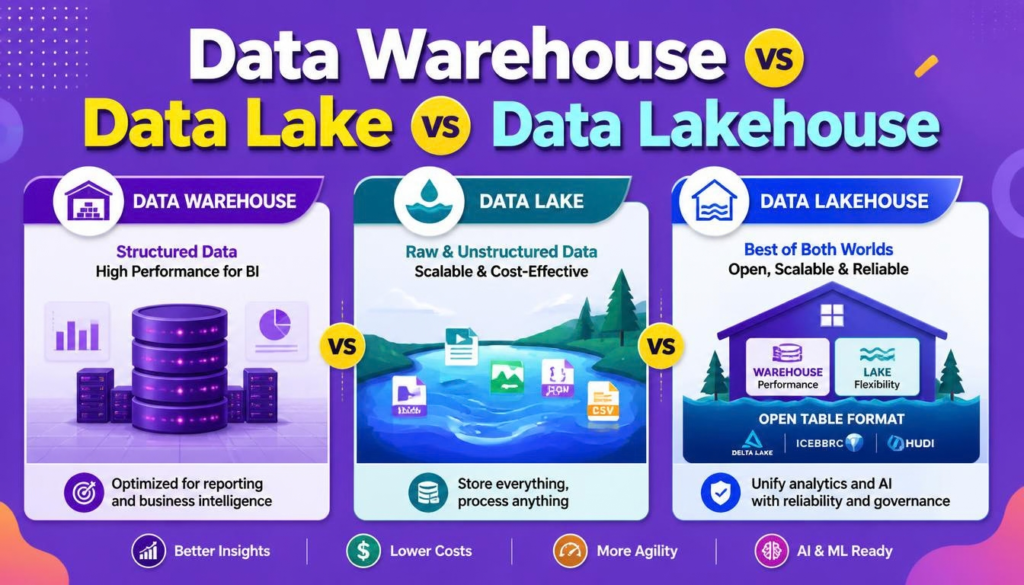
Modern businesses generate huge amounts of information every second from web traffic, mobile applications, financial transactions, IoT sensors, and marketing campaigns. Storing this information is only half the battle; organizations must also organize, clean, analyze, and query it efficiently. When setting up modern storage pipelines, comparing a data warehouse vs data lake vs data lakehouse helps engineers choose the right foundation for analytics and machine learning.
Although all three systems store massive datasets, they were built around fundamentally different engineering principles. Understanding how a data warehouse vs data lake vs data lakehouse operates ensures your team builds a cost-effective, scalable data infrastructure.
What Is a Data Warehouse?
A data warehouse is a centralized platform engineered specifically for storing highly structured, curated data to drive business intelligence (BI) and reporting. Before any record enters a warehouse, it undergoes strict cleaning, structural transformation, and schema validation.
┌─────────────────────────────────────────────────────────────┐
│                 Data Warehouse Workflow                     │
├─────────────────────────────────────────────────────────────┤
│ Data Sources ──> ETL / ELT ──> Data Warehouse ──> BI Tools  │
└─────────────────────────────────────────────────────────────┘
Warehouses excel at fast relational queries, financial reporting, executive dashboards, and performance monitoring. For example, an e-commerce platform cleans web traffic, checkout records, and inventory logs before loading them into a centralized warehouse for daily sales tracking.
How Warehouses Work
Data warehouses rely on schema-on-write, meaning the table structure must be defined before loading data. They utilize either ETL (Extract, Transform, Load) or ELT (Extract, Load, Transform) pipelines.
- Benefits: Lightning-fast SQL performance, strong transaction compliance, unified data governance, and reliable dashboard reporting.
- Limitations: Inflexible with unorganized video, audio, or raw JSON logs; higher storage costs for massive scale.
Evaluating a data warehouse vs data lake vs data lakehouse shows that warehouses remain the gold standard when structured reporting is your top priority.
What Is a Data Lake?
A data lake is a highly flexible storage repository designed to hold vast amounts of raw data in its native format. Unlike structured warehouses, lakes accept data without requiring pre-defined table structures or schemas.
┌─────────────────────────────────────────────────────────────┐
│                   Data Lake Workflow                        │
├─────────────────────────────────────────────────────────────┤
│ Diverse Sources ──> Raw Storage ──> Engine ──> AI / Analytics│
└─────────────────────────────────────────────────────────────┘
A data lake easily ingests:
- Structured Data: Relational tables and database exports.
- Semi-Structured Data: JSON payloads, XML, and server logs.
- Unstructured Data: Images, audio files, video feeds, and IoT sensor streams.
How Data Lakes Work
Data lakes utilize schema-on-read. Raw files are stored immediately at low cost, and structure is applied only when a processing engine reads the file.
- Benefits: Massive scalability, cheap object storage, support for raw unstructured formats, and deep integration with data science frameworks.
- Limitations: Without proper metadata tagging and governance, a lake quickly turns into a messy “data swamp” that is difficult to query.
When weighing a data warehouse vs data lake vs data lakehouse for machine learning research, data lakes provide the raw material data scientists need.
What Is a Data Lakehouse?
A data lakehouse is a modern hybrid architecture that combines the low-cost flexibility of a data lake with the governance, transaction consistency, and query speed of a data warehouse.
┌─────────────────────────────────────────────────────────────┐
│                 Data Lakehouse Workflow                     │
├─────────────────────────────────────────────────────────────┤
│ Raw Data ──> Open Object Storage + Lakehouse Layer ──> BI & AI│
└─────────────────────────────────────────────────────────────┘
Instead of running separate platforms for reporting and data science, a lakehouse implements open table formats directly over low-cost object storage. To explore how lakehouse storage layers operate in enterprise environments, read through the technical documentation on Databricks.
How Data Lakehouses Work
Lakehouses layer metadata management, ACID transactions, data versioning, and indexing directly on top of flexible lake files. This architecture allows both SQL analysts and ML engineers to query a single unified dataset without copying records back and forth.
Analyzing a data warehouse vs data lake vs data lakehouse reveals that the lakehouse framework minimizes duplicate infrastructure while serving BI dashboards and machine learning models simultaneously.
Comparing the Three Architectures
A direct head-to-head breakdown of a data warehouse vs data lake vs data lakehouse illustrates key structural trade-offs:
| Feature | Data Warehouse | Data Lake | Data Lakehouse |
| Primary Focus | BI & SQL Reporting | Flexible Big Data Storage | Unified Analytics & AI |
| Data Format | Highly Structured | Structured, Semi-, Unstructured | Structured, Semi-, Unstructured |
| Schema Paradigm | Schema-on-write | Schema-on-read | Flexible with managed schemas |
| Storage Cost | Premium / High | Low-cost object storage | Low-cost object storage |
| Query Speed | Ultra-fast for SQL | Variable (depends on engine) | Fast SQL + direct ML access |
| Governance | Strict & Built-in | Requires external management | Integrated open table governance |
Reviewing these features in a data warehouse vs data lake vs data lakehouse context helps engineering leads select the right tool for their workload demands.
Schema-on-Write vs Schema-on-Read
Understanding structural enforcement clarifies how a data warehouse vs data lake vs data lakehouse manages data ingestion:
- Schema-on-Write: You design the database schema first, transform the data to fit that schema, and write it to disk. This is ideal for financial reports where accuracy and structure are mandatory.
- Schema-on-Read: You dump raw files directly into storage and apply a schema on the fly during query execution. This works best when storing high-velocity logs, clickstreams, or raw sensor feeds.
Real-World Examples
Seeing a data warehouse vs data lake vs data lakehouse in action highlights their distinct strengths across real business setups:
- The Warehouse Approach: A retail company ingests daily store transactions into a centralized warehouse. The finance team runs daily SQL queries to generate profit reports and sales tracking dashboards.
- The Lake Approach: A tech company collects raw app telemetry, clickstream logs, customer support chats, and audio recordings into object storage. Data scientists process these raw assets to build experimental natural language processing models.
- The Lakehouse Approach: A digital platform streams real-time user activity into open object storage. SQL analysts run BI dashboards directly on managed lakehouse tables, while automated prediction services pull the same data for real-time recommendation engines. If your team builds low-latency decision loops or automated pipelines, exploring automated trading bot strategies demonstrates how real-time execution flows operate.
Practical Selection Framework
When choosing between a data warehouse vs data lake vs data lakehouse, use this simple decision matrix:
┌─────────────────────────────────────────────────────────────┐
│                 Architecture Selection Flow                 │
├─────────────────────────────────────────────────────────────┤
│ Need structured SQL & financial BI? ──> Data Warehouse      │
│ Need low-cost raw storage for ML? ──> Data Lake             │
│ Need unified BI + AI on shared data? ──> Data Lakehouse     │
└─────────────────────────────────────────────────────────────┘
- Select a Data Warehouse if your primary requirement is structured executive reporting, fast SQL execution, and strict governance without unorganized data formats.
- Select a Data Lake if you collect massive volumes of unstructured media, raw telemetry, or web logs for data science exploration.
- Select a Data Lakehouse if you want to eliminate duplicate data pipelines by running SQL analytics and machine learning models on a shared platform.
Cost, Security, and Governance Considerations
Evaluating a data warehouse vs data lake vs data lakehouse requires analyzing total cost of ownership alongside security guarantees:
- Cost Optimization: Data lakes offer cheap storage but incur high processing costs if queries are unoptimized. Warehouses offer predictable analytical query performance but scale up storage costs quickly. Lakehouses balance storage and compute costs by separating storage layers from query engines.
- Security & Governance: A warehouse provides out-of-the-box role-based access control. Data lakes require intentional metadata catalogs and permission policies to prevent data swamps. Lakehouses integrate transaction logs and access controls over open object stores.
Carefully assessing a data warehouse vs data lake vs data lakehouse guarantees that your data architecture aligns with your team’s technical skills, analytical goals, and budget constraints.
Which storage framework from data warehouse vs data lake vs data lakehouse is your team implementing this year? Share your experiences and questions in the comments below!