How AI Automated Chatbots Solve Support Problems in 2026

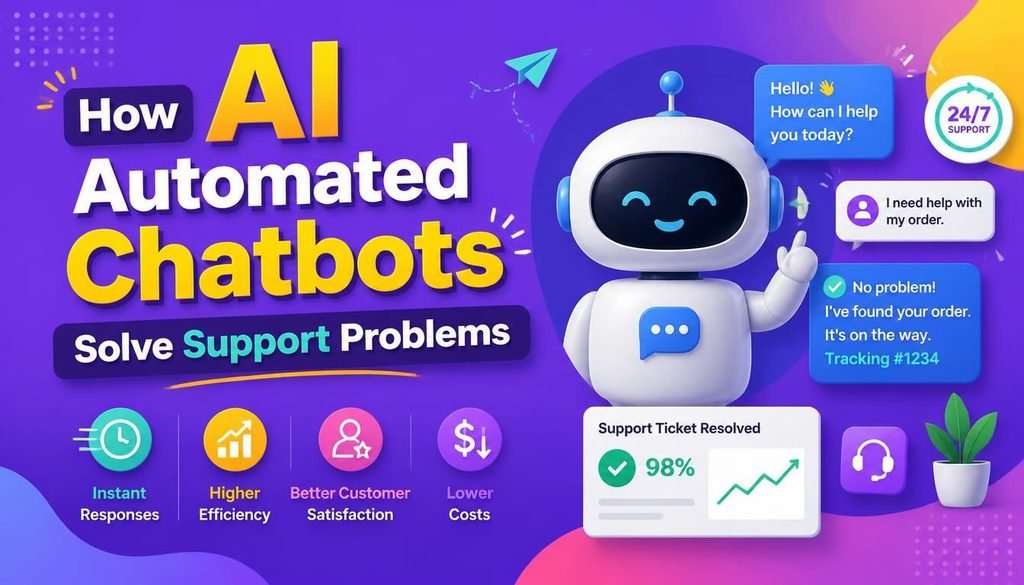
If you run an online store, a SaaS startup, or a local service business, you already know the drill. A customer has a problem at 11:00 PM, they send an urgent email, and they expect a reply within minutes. If they don’t get one, they get frustrated, leave a bad review, or jump over to a competitor.
Meeting these high expectations is notoriously difficult. Hiring enough support agents to cover every shift and handle every inquiry is financially impossible for most growing companies. Your team gets overwhelmed by the same repetitive questions, wait times increase, and customer satisfaction drops.
This is exactly how AI automated chatbots solve support problems for modern businesses. Instead of relying on a human to manually type out a password reset guide for the hundredth time this week, intelligent virtual assistants handle the heavy lifting. They provide instant, accurate answers around the clock, freeing your human team to tackle the complex issues that actually require empathy and critical thinking.
Let’s break down exactly how AI automated chatbots solve support problems today, and practical ways you can integrate them into your own business.
Moving Beyond the Old “Press 1 for Support” Bots
We all remember the old chatbots from a few years ago. They were rigid, frustrating, and usually ended with the customer aggressively typing “SPEAK TO A HUMAN.”
Modern AI chatbots are entirely different. Powered by natural language processing (NLP), they actually understand the context of what a customer is typing. When looking at how AI automated chatbots solve support problems, their ability to read a messy, typo-filled sentence and still pull up the correct shipping data is the real game-changer.
Furthermore, today’s AI agents plug directly into your existing software stack, including:
- CRM platforms (like Salesforce or HubSpot)
- E-commerce dashboards (like Shopify)
- Help desk software (like Zendesk)
- Payment gateways
Instead of just linking to an FAQ article, the AI can actively process a refund, reschedule an appointment, or track a lost package in real time.
1. Eliminating the Customer Waiting Line
When founders ask how AI automated chatbots solve support problems, the answer almost always starts with raw speed.
Long wait times are the number one killer of customer retention. AI chatbots respond in milliseconds. Instead of sitting in a support queue for 45 minutes, a customer instantly gets answers to routine questions like:
- “Where is my order?”
- “What are your business hours?”
- “How do I upgrade my subscription?”
Killing the wait time instantly boosts your customer satisfaction scores and stops support tickets from piling up in your inbox.
2. Providing True 24/7 Availability
Your business might close at 5:00 PM, but the internet doesn’t.
Unlike human agents, AI chatbots do not need sleep, coffee breaks, or holiday pay. They provide flawless support on weekends, overnight, and across multiple international time zones. If you have customers in Europe while your team is asleep in North America, the AI acts as your dedicated night shift.
Industry benchmark reports published by research leaders like Gartner reveal that conversational AI and automated virtual agents continue to drastically reduce customer service operational overhead worldwide.
3. Destroying Repetitive Workloads
Support teams burn out when they have to act like copy-and-paste robots. Answering “Do you offer free shipping?” fifty times a day drains employee morale.
By automatically handling these routine, low-level inquiries, the AI intercepts the noise. Your human agents only step in when a customer has a unique, complicated, or highly sensitive issue.
4. Drastically Lowering Operational Costs
Another massive factor in how AI automated chatbots solve support problems is overhead cost reduction.
Hiring, training, and managing a massive customer support floor requires a huge budget. AI allows you to scale your support capacity infinitely without doubling your payroll. During a busy holiday season or a major product launch, a single AI chatbot can handle 10,000 simultaneous conversations. You get enterprise-level support capacity on a small business budget.
5. Partnering with Human Agents (Not Replacing Them)
A common fear is that AI will replace human support completely. The reality of how AI automated chatbots solve support problems is that they act as intelligent assistants to your existing staff.
When an AI encounters a highly emotional customer or a complex billing dispute, it seamlessly transfers the chat to a human. The human agent receives the entire chat transcript, so the customer never has to repeat themselves. It is a tag-team approach that creates a frictionless experience.
Practical Industry Use Cases
To visualize how AI automated chatbots solve support problems in the real world, let’s look at how different industries use them:
| Industry | Primary AI Automation Tasks |
| E-Commerce | Order tracking, return processing, product recommendations |
| SaaS & Tech | Password resets, software troubleshooting, onboarding guides |
| Healthcare | Appointment scheduling, basic health FAQs, clinic hours |
| Banking | Checking account balances, reporting lost cards, fraud alerts |
Breaking the Language Barrier
As businesses expand globally, hiring multilingual support agents becomes expensive. Modern AI chatbots natively process and translate multiple languages in real-time. A customer can type a question in Spanish, the AI references your English database, and replies flawlessly in Spanish. This opens your business to entirely new international markets with zero extra effort.
Best Practices for a Smooth Launch
You cannot just flip a switch and expect an AI to know everything about your business. To maximize how AI automated chatbots solve support problems, you need a solid setup strategy:
- Feed it Good Data: Train your AI on your most successful past support tickets, detailed FAQs, and clear company policies.
- Always Offer an Escape Hatch: Never trap a customer with an AI. Always provide a clear, visible button to “Talk to a Human.”
- Review the Transcripts: Spend an hour every week reading through the AI’s conversations. You will quickly spot areas where it gets confused, allowing you to update its training data.
Developers and tech founders often share open-source integrations and training frameworks on GitHub, making it easier than ever to build customized support workflows.
To see how AI integrations fit into broader digital growth strategies, explore our detailed guide on Latest Software and AI Tech Trends.
Final Thoughts
At the end of the day, seeing how AI automated chatbots solve support problems completely changes the way you view customer service. You stop looking at support as a massive expense and start seeing it as an efficient, streamlined machine.
By handling the repetitive tasks, providing instant replies 24/7, and seamlessly escalating complex issues to your human team, AI allows your business to deliver world-class service without breaking the bank.
Frequently Asked Questions (FAQs)
Are AI chatbots safe for handling sensitive customer data?
Yes, as long as you choose a reputable AI provider. Top-tier chatbot platforms comply with SOC2, GDPR, and HIPAA standards, ensuring customer data is encrypted and securely handled.
Do I need to know how to code to set up an AI chatbot?
No. Most modern AI support platforms (like Intercom, Zendesk AI, or CustomGPT) offer visual, drag-and-drop builders. You simply connect the tool to your website and upload your company documents.
What happens if the AI gives a customer the wrong answer?
This is why human escalation is vital. If the AI detects confusion or negative sentiment, it should automatically route the ticket to a human. Regularly reviewing chat logs helps you correct the AI’s knowledge base so it doesn’t make the same mistake twice.
What Do You Think?
Now that we’ve covered exactly how AI automated chatbots solve support problems, we’d love to hear from you. Have you implemented an AI bot on your website yet, or are you still relying 100% on a human team? Drop your experiences or questions in the comments below!





5 Comments