12 Essential Ethical AI Guidelines: The Ultimate Developer Framework for 2026!

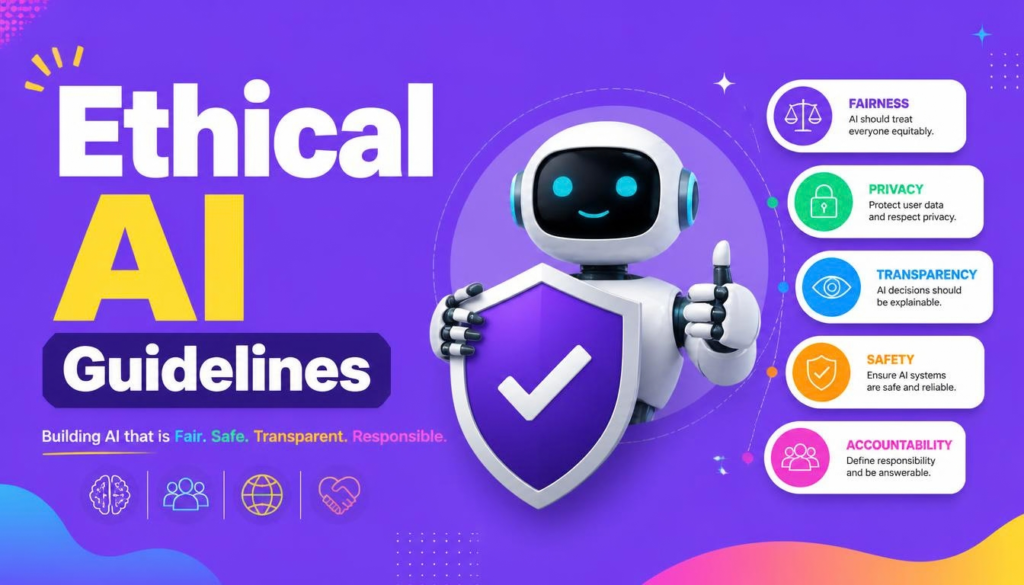
Artificial intelligence is no longer an experimental side project. It’s actively driving healthcare diagnostic tools, financial trading systems, education platforms, and automated customer workflows. But as algorithms start making decisions that directly affect people’s daily lives, software engineers are running into a tough truth: getting a model to work with high accuracy isn’t enough anymore. We have to make sure it handles real people’s data safely, fairly, and predictably by implementing proven ethical AI guidelines.
If you’ve ever trained a model that pulled unexpected bias from noisy training data, or struggled to explain why an algorithm generated a specific output, you know how deceptive pure accuracy metrics can be. Following comprehensive ethical AI guidelines isn’t about slowing down technical innovation or filling your sprint cycles with endless corporate compliance rules. It’s about putting smart engineering checks into your codebase from day one.
What Ethical AI Means in Real-World Code
When we talk about applying ethical AI guidelines, we’re moving past abstract philosophy and looking at day-to-day engineering habits. It means building software that respects user privacy, catches algorithmic skew early, stays clear about its internal logic, and gives humans the final say whenever the stakes are high.
┌─────────────────────────────────────────────────────────────┐
│                 Core Ethical AI Pillars                    │
├─────────────────────────────────────────────────────────────┤
│ Fairness ──> Privacy ──> Transparency ──> Human Oversight    │
└─────────────────────────────────────────────────────────────┘
A practical framework built on ethical AI guidelines focuses on how technical decisions ripple outward into the real world. Key focus areas include:
- Fairness & Bias Checks: Testing model outputs across different user groups to prevent skewed predictions.
- Privacy & Data Handling: Collecting only what your application actually needs, anonymizing logs, and setting clean data retention rules.
- Explainability: Choosing architectures and diagnostic tools that let you trace why a model reached a specific decision.
- Security & System Resilience: Protecting your API pipelines against prompt injection, model inversion, and data poisoning.
- Human-in-the-Loop Safeguards: Setting up fallback mechanisms so real operators can review low-confidence automated outputs.
Why Technical Safeguards Pay Off Early
As developers, our code choices directly dictate how automated systems behave under pressure. Every dataset we clean, every confidence threshold we adjust, and every third-party API we tie together has a practical impact.
| Engineering Focus | Architecture Choice | Real-World Impact |
|---|---|---|
| Data Curation | Training on unvetted or skewed historical data | Replicates past errors and amplifies systemic bias |
| Data Visibility | Storing unnecessary personal identifiers in database tables | Creates major security risks during accidental leaks |
| Output Delivery | Streaming raw generative outputs directly to end users | Exposes users to hallucinations and unverified claims |
| Execution Logic | Running end-to-end fully autonomous actions | Leaves no clean way for admins to interrupt error loops |
Adopting core ethical AI guidelines early in development helps catch these edge cases long before code hits production. If you build algorithmic systems or logic-heavy automation, checking out https://tayoalgo.com/how-ai-automated-chatbots-solve-support-problems/ shows how clear boundary logic and strict risk rules protect users in live environments.
12 Essential Ethical AI Guidelines for Developers
1. Set Hard System Boundaries First
Before writing code, define what your system should do—and explicitly what it must never do. Establishing clear boundary conditions prevents scope creep and keeps models from making decisions outside their trained domain.
2. Practice Minimal, Intentional Data Collection
More data isn’t always better; cleaner data is. Limit collection to fields essential for your core feature, track data lineage, verify source accuracy, and strip out unnecessary personal information before model training begins.
3. Test Regularly for Hidden Bias
Models reflect the patterns in their training data, including old errors. Measure false-positive and false-negative rates across different user segments so your application performs consistently for everyone.
4. Build Privacy Controls Directly Into Your Architecture
Treat user privacy as a default setting, not a post-launch add-on. Enforce end-to-end encryption, strict database permissions, and input sanitization. Double-check that sensitive user prompts never leak into standard error logs or debugging tools. For recognized industry standards aligned with modern ethical AI guidelines, refer to the IEEE Global Initiative on Ethics of Autonomous and Intelligent Systems.
5. Be Honest About Automated Content
Don’t trick users into thinking they are interacting with a human when they’re talking to a bot. Label AI-generated text, audio, and visual outputs clearly, and state system limits up front.
┌─────────────────────────────────────────────────────────────┐
│               High-Impact Human Oversight Loop              │
├─────────────────────────────────────────────────────────────┤
│ Model Output ──> Confidence Check ──> Human Review ──> Action│
└─────────────────────────────────────────────────────────────┘
6. Keep Humans in the Loop for High-Stakes Actions
Automation should assist human decision-makers, not replace them in critical domains like health, credit scoring, or legal assessments. Build clear interfaces where team members can review automated suggestions before changes hit production.
7. Harden Model Security Early
Secure code is a baseline requirement for responsible software. Guard your endpoints against prompt injection techniques, API abuse, and data exfiltration. A model that leaks sensitive user inputs fails basic ethical AI guidelines no matter how fast or accurate it runs.
8. Match Decision Explainability to the Risk Level
Not every feature needs complex diagnostic logging. A recommendation widget on a blog only needs basic reasoning logic, whereas a loan evaluation engine requires clear feature-importance readouts so users understand the result.
9. Stress-Test Your Systems Against Real-World Noise
Clean test datasets rarely reflect what users throw at live applications. Stress-test your pipelines against ambiguous inputs, broken formatting, missing context, and intentional edge-case inputs to see how gracefully the system handles unexpected states.
10. Give Users a Direct Path to Flag Mistakes
Algorithms get things wrong. Give your users simple, clear ways to report errors, request a manual review, or correct bad data without feeling stuck in an automated loop.
11. Keep Clean Technical Documentation
Good documentation keeps engineering teams accountable as systems grow. Aligning your workflow with ethical AI guidelines requires tracking key details across these primary areas:
| Focus Area | What to Document |
|---|---|
| Scope & Intent | Primary goals, operational limits, and target user groups |
| Data Lineage | Source origin, cleaning steps, and known dataset gaps |
| Model Setup | Model type, versioning, parameters, and active guardrails |
| Security Audits | Access controls, rate limit settings, and penetration test notes |
12. Track Performance Long After Deployment
Pushing code to production is where real monitoring begins. Following practical ethical AI guidelines means tracking performance metrics continuously to spot data drift, unexpected latency spikes, or new edge cases as live usage patterns evolve over time.
A Simple 6-Stage Development Engine
┌─────────────────────────────────────────────────────────────┐
│                 6-Stage AI Lifecycle Engine                 │
├─────────────────────────────────────────────────────────────┤
│ 1. DEFINE  ──> 2. ASSESS ──> 3. BUILD                      │
│ 4. TEST    ──> 5. DEPLOY ──> 6. MONITOR                    │
└─────────────────────────────────────────────────────────────┘
Rather than treating ethical AI guidelines as a one-time checklist, embed them directly into your release cadence:
- Define: Map out project goals, set boundary limits, and identify edge cases early.
- Assess: Audit your data sources, review privacy requirements, and note potential failure modes.
- Build: Write clean validation checks, setup guardrail layers, and build fallback workflows.
- Test: Run adversarial checks, test for group performance balance, and review error handling.
- Deploy: Ship system documentation, enable diagnostic logging, and open clear feedback loops.
- Monitor: Watch real-world accuracy, track performance drift, and patch anomalies quickly.
Developer Pre-Release Check
Before pushing your next intelligent feature or model update live, run through these quick checks to ensure compliance with your ethical AI guidelines:
- [ ] Are system boundaries and functional limits clearly mapped out?
- [ ] Is data collection trimmed down to only essential fields?
- [ ] Have you tested the model across varied user groups for balanced accuracy?
- [ ] Are security guards active to block prompt injections and leaks?
- [ ] Is it clear to users when they are interacting with automated software?
- [ ] Is there an easy way for an operator to override low-confidence actions?
- [ ] Are monitoring alerts active to catch live model drift?
Building software with clear ethical AI guidelines in mind isn’t about adding friction to your sprint—it’s about making your systems reliable, secure, and predictable over time. When privacy, transparency, and sensible human oversight are baked straight into your architecture, you build products that users can actually trust for the long haul.
What strategies has your team used to enforce ethical AI guidelines in live production environments? Drop your thoughts or questions in the comments below!