What Is Edge AI? 5 Game-Changing Reasons AI Is Moving to Local Devices

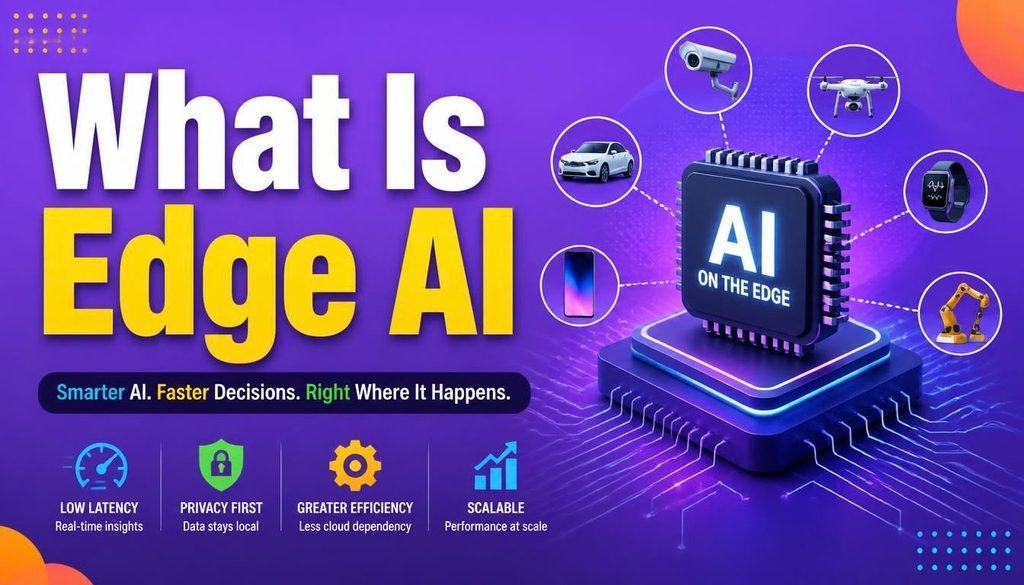
For years, we’ve been conditioned to think that artificial intelligence lives somewhere high up in the cloud. Every time you ask a digital assistant a question or run a photo through a smart filter, your phone sends that data across oceans to a massive, humming data center, waits for a decision, and streams the answer back.
It’s an impressive setup, but honestly? It isn’t always practical.
If you’ve been tracking where tech is heading, you’ve probably noticed a quiet revolution taking place right in our hands and pockets. We are shifting toward processing data right where it happens. Understanding what is Edge AI starts with this simple idea: bringing the brain of artificial intelligence directly onto physical hardware like your smartphone, a smart security camera, an autonomous vehicle, or a factory robot.
Instead of constantly relying on distant servers, learning what is Edge AI allows you to see how devices think, learn, and react locally in real time.
What Is Edge AI, Exactly?
To break down what is Edge AI without getting lost in technical jargon, think of it as moving processing power from a centralized warehouse to your front doorstep.
So, what is Edge AI in technical terms? It refers to running machine learning algorithms directly on local hardware endpoints—or nearby local edge gateways—without needing an active, high-speed internet connection to make decisions.
┌─────────────────────────────────────────────────────────────┐
│                   Cloud vs. Edge AI Workflow                │
├─────────────────────────────────────────────────────────────┤
│ Cloud Architecture: Device ──> Internet ──> Cloud ──> Device│
│ Edge AI Workflow:   Device ──> Onboard AI ──> Instant Action│
└─────────────────────────────────────────────────────────────┘
The word “edge” simply refers to the physical boundary where digital systems meet the real world—the edge of the network. If you’re curious about how chipmakers are redesigning silicon for this shift, exploring what is Edge AI hardware leads directly to technical blueprints at NVIDIA Embedded Systems.
Does this mean the cloud is dead? Not at all. Modern technology relies on a hybrid balance: time-sensitive decisions happen locally on the device, while long-term data storage, heavy trend analysis, and massive model training stay comfortably in the cloud.
How Does Edge AI Actually Work?
When you look at what is Edge AI from a practical, day-to-day operational standpoint, the system follows a quick four-step cycle:
┌─────────────────────────────────────────────────────────────┐
│                 Edge AI Execution Pipeline                  │
├─────────────────────────────────────────────────────────────┤
│ Data Capture ──> Local Preprocessing ──> Neural Inference   │
│              ──> Instant Local Action                        │
└─────────────────────────────────────────────────────────────┘
- Capturing Telemetry: Local hardware collects raw environmental data through embedded sensors, lenses, or microphones.
- Cleaning the Inputs: The device cleans up, crops, or normalizes this data in local memory so the AI can read it efficiently.
- Running the Inference: A compact machine learning model stored on the chip evaluates the input to spot patterns or make a prediction.
- Taking Immediate Action: The device responds on the spot—whether that means slamming on autonomous brakes, flagging a defect, or sounding an alarm.
Analyzing what is Edge AI in execution shows how local inference skips the delays of long-distance data transmission.
5 Reasons AI Is Moving From Cloud Servers to Local Devices
Understanding what is Edge AI becomes crystal clear when you look at the real-world friction points it solves:
1. Ultra-Low Latency (Because Split Seconds Matter)
In many real-world scenarios, waiting half a second for a cloud server to respond is half a second too late.
┌─────────────────────────────────────────────────────────────┐
│                    Response Time Latency                    │
├─────────────────────────────────────────────────────────────┤
│ Cloud Processing: 150ms ──> 500ms (Network Dependent)       │
│ Edge Processing:  1ms   ──> 15ms  (Instant & Reliable)      │
└─────────────────────────────────────────────────────────────┘
Imagine an industrial robot working alongside humans on an assembly line. If an engineer steps into the robot’s path, waiting for a camera feed to travel to a cloud data center and back could cause a serious accident. By evaluating video frames locally, local algorithms cut latency down to single-digit milliseconds, triggering an immediate safety stop.
2. Protecting Privacy at the Source
We live in an era where data privacy is a top priority for both consumers and enterprises. Sending continuous live video streams, voice recordings, or confidential medical files across external networks creates unnecessary security risks.
When evaluating what is Edge AI for privacy-conscious applications, the key benefit is that raw sensitive data never leaves your device. For instance, a smart home camera can analyze a video feed locally to detect a person, sending a simple text notification to your phone while keeping the actual video stored safely on local storage.
3. True Offline Independence
Cloud-dependent tech becomes useless the moment you lose internet access. But real life happens in places with terrible connectivity—remote farms, underground mines, cargo ships, or rural highways.
Local processing ensures that devices keep working regardless of network health. An agricultural drone scanning crops for disease can analyze thousands of leaves in the middle of a remote field and sync its summary report hours later when it reconnects to Wi-Fi.
4. Cutting Down Massively on Bandwidth and Storage Costs
Streaming continuous 4K video from dozens of security cameras eats up immense network bandwidth and leads to eye-watering cloud hosting bills.
On-device intelligence fixes this by acting as a smart filter right at the camera lens. Instead of dumping endless hours of empty hallway footage into the cloud, the local model only uploads short clips when something noteworthy actually happens. This simple shift can cut cloud bandwidth and storage costs by up to 90%.
5. Smarter Chips and Smaller Models
The rapid growth of local computing isn’t just a trend; it’s a hardware reality. Modern smartphones, laptops, and IoT boards now ship with built-in Neural Processing Units (NPUs) designed specifically to execute AI math with minimal battery draw.
At the same time, software engineers have mastered model compression techniques:
- Quantization: Trimming mathematical precision down so models take up 70% less memory.
- Pruning: Snapping off inactive neural connections that don’t add value to the final output.
- Knowledge Distillation: Teaching small, lightning-fast “student” models to replicate the intelligence of massive “teacher” algorithms.
Edge AI vs. Cloud AI: A Direct Comparison
Grasping what is Edge AI requires looking at how it measures up against traditional cloud architectures side-by-side:
| Feature | Edge AI | Cloud AI |
| Where Processing Happens | Directly on the local device or gateway | In a distant, centralized data center |
| Speed / Latency | Near-instant (1–10 milliseconds) | Variable (100–500+ milliseconds) |
| Internet Requirement | Works completely offline | Needs a steady, fast connection |
| Privacy Footprint | High (sensitive data stays local) | Lower (raw data travels over networks) |
| Compute Power | Efficient, but bounded by chip size | Virtually unlimited server power |
| Best Practical Use | Real-time actions & instant triggers | Deep model training & massive analytics |
Where You Can See Edge AI Working Today
You might be surprised by how much local intelligence you already interact with daily:
- Connected Vehicles: Real-time lane assistance and emergency braking features rely on immediate local vision processing.
- Smart Manufacturing: High-speed optical cameras spot microscopic manufacturing defects on assembly lines before products are packaged.
- Modern Healthcare: Portable ultrasound scanners run local AI models to help nurses spot internal abnormalities right at the patient’s bedside.
- Retail & Logistics: Inventory cameras track stock levels on shelves locally without needing to stream raw footage to central offices.
If your team is exploring automated workflows or combining local hardware triggers with software automation, reading our breakdown on Robotic Process Automation and AI integration offers practical architecture ideas.
Deployment Readiness Checklist
Thinking about bringing AI down to local devices in your own operations? Understanding what is Edge AI deployment involves checking these core requirements:
- [ ] Have you confirmed that your project actually needs instant response times or offline capabilities?
- [ ] Is your target hardware equipped with specialized NPU, GPU, or TPU silicon?
- [ ] Has your machine learning model been quantized to fit comfortably within the device’s RAM limits?
- [ ] Do you have a secure Over-The-Air (OTA) update pipeline to push model improvements safely?
- [ ] Is there a clear human-in-the-loop fallback system if the local AI encounters an uncertain scenario?
At its core, learning what is Edge AI shows us where technology is naturally heading: toward faster, quieter, and more independent systems. By pairing instant local execution with the long-term analytical power of the cloud, we get the best of both worlds—smart devices that respect our time, privacy, and connectivity limits.
Now that you understand what is Edge AI and its main advantages, are you working on moving any AI features to local hardware or building hybrid systems this year? Drop your thoughts, questions, or setup ideas in the comments section below!