10 Proven Big Data Processing Steps: Architectures & Tools for 2026!

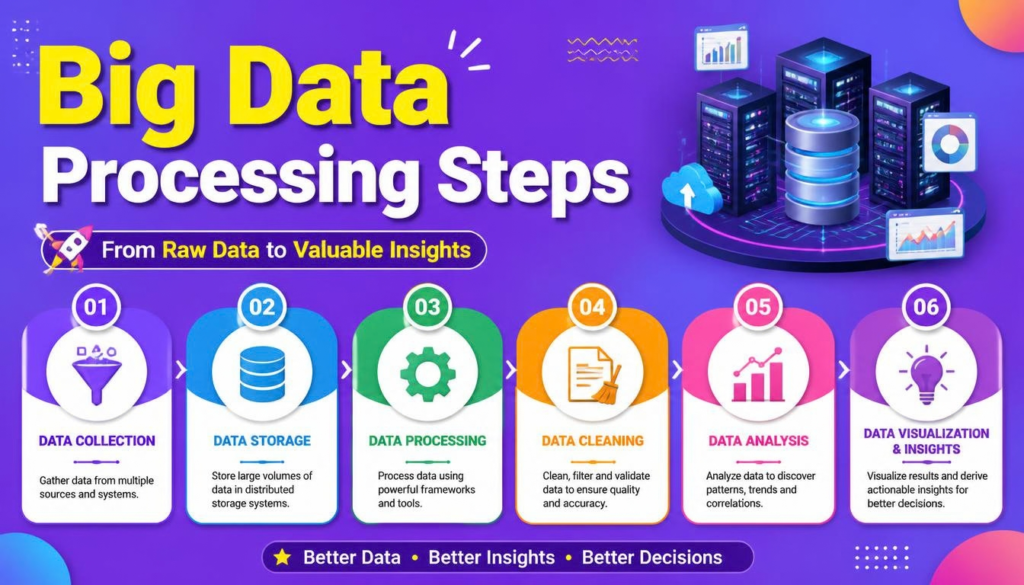
Every single second, the modern software ecosystem generates an astonishing volume of information. E-commerce platforms log customer clicks, IoT sensors stream telemetry metrics, payment gateways process transactions, and social networks absorb millions of media uploads. The core challenge facing software teams today isn’t just capturing these massive datasets—it’s running efficient big data processing workflows to convert raw noise into actionable intelligence.
If you’ve ever managed a database that locked up under high concurrency or tried to query unindexed log archives, you already know traditional relational databases hit a performance wall very quickly. Modern data workloads require distributed computing pipelines, purpose-built storage layers, and resilient streaming frameworks. Implementing a modern approach to big data processing helps developers and architects bypass these hardware limitations entirely.
What Is Big Data Processing in Practice?
At its core, big data processing refers to the architecture, distributed engines, and operational pipelines used to collect, store, transform, and query massive datasets across cluster nodes. Instead of relying on a single high-spec server, distributed systems divide heavy compute workloads across hundreds of interconnected machines.
┌─────────────────────────────────────────────────────────────┐
│                 Data Pipeline Workflow                      │
├─────────────────────────────────────────────────────────────┤
│ Sources ──> Ingestion ──> Storage ──> Processing ──> Insights│
└─────────────────────────────────────────────────────────────┘
A functional pipeline built for scale converts high-velocity data into clean metrics. Typical sources fed into big data processing pipelines include:
- Transactional Systems: Online orders, account balances, and inventory updates.
- Telemetry & Event Logs: Clickstream events, API request metrics, and server diagnostics.
- Unstructured Content: Raw JSON payloads, media uploads, and customer support tickets.
When done correctly, modern big data processing allows companies to detect fraudulent payments in milliseconds, optimize supply chains on the fly, and personalize user feeds in real time.
Beyond Traditional Databases: The 5 Vs
Traditional relational databases work exceptionally well for structured tables and predictable query patterns. However, modern applications generate information at scales that overwhelm standard SQL setups.
| Characteristic | Meaning | Practical Engineering Challenge |
| Volume | Scale of generated data | Requires distributed object storage and file systems |
| Velocity | Speed of incoming streams | Demands real-time event brokers and streaming engines |
| Variety | Mix of structured & unstructured formats | Requires flexible schema-on-read architectures |
| Veracity | Data quality and reliability | Demands automated deduplication and cleaning pipelines |
| Value | Derived business insights | Requires low-latency query engines and analytics layers |
Building a modern framework around big data processing ensures your infrastructure can absorb this volume without crashing live application services.
The 10 Proven Steps of Big Data Processing
To build a fault-tolerant system that scales smoothly, most production pipelines execute these 10 distinct operational steps:
Step 1: Data Generation & Ingestion
Data flows continuously from mobile apps, IoT edge nodes, and server logs. Lightweight message brokers capture these incoming streams without blocking application performance.
Step 2: Stream Buffering
Before hitting long-term storage, high-velocity events pass through distributed event brokers (like Kafka) to handle traffic surges and prevent downstream bottlenecks.
Step 3: Raw Landing & Storage Tiering
Data lands in low-cost storage layers like cloud object stores or distributed file systems, preserving uncompressed raw records for audit and compliance needs.
Step 4: Schema Validation & Parsing
Incoming payloads pass through automated validation gateways. Corrupted records or unexpected JSON formats get isolated into dead-letter queues for review.
Step 5: Data Cleaning & Deduplication
Engineers set up big data processing workflows to strip null values, standardize date/time formats, and remove duplicate event records across cluster nodes.
┌─────────────────────────────────────────────────────────────┐
│              Batch vs. Stream Execution Loop                │
├─────────────────────────────────────────────────────────────┤
│ Batch:  Collect ──> Store ──> Scheduled Job ──> Report       │
│ Stream: Event   ──> Real-Time Engine    ──> Immediate Action │
└─────────────────────────────────────────────────────────────┘
Step 6: Transformation & Aggregation
Data engines compute real-time metrics, aggregate session histories, join multi-table datasets, and calculate key performance indicators on the fly.
Step 7: Indexing & Analytical Loading
Cleaned records load into analytical databases or column-oriented data warehouses optimized for low-latency SQL querying.
Step 8: Security & Governance Enforcement
Access controls, column-level encryption, and data masking protocols ensure sensitive records remain fully protected during downstream analytics.
Step 9: Analytics & ML Consumption
Business intelligence dashboards, reporting engines, and automated machine learning pipelines query the prepared data tiers directly.
Step 10: Continuous Performance Monitoring
System metrics track query speed, storage costs, and resource consumption to ensure long-term stability as data volume grows.
Dominant Architectural Patterns
When designing an engine for big data processing, architects rely on proven patterns to structure their data flow:
- Lambda Architecture: Splitting execution into two distinct paths: a batch layer for absolute historical accuracy and a speed layer for low-latency streaming. A unified serving layer merges both outputs for user queries.
- Kappa Architecture: Streamlining system complexity by routing all data through a single event-driven streaming pipeline. Historical re-runs happen by simply reprocessing stored immutable log streams.
- Lakehouse Architecture: Combining the low-cost, flexible storage of data lakes with the ACID compliance, governance, and schema enforcement of data warehouses.
Key Open-Source Frameworks & Cloud Engines
Building robust infrastructure requires selecting the right tools for your workload profile:
- Apache Spark: The industry-standard distributed engine for fast, in-memory big data processing across batch, streaming, and machine learning workloads.
- Apache Kafka: A high-throughput, distributed event stream platform used to decouple application services and build real-time event pipelines.
- Apache Flink: A stateful stream-processing framework designed for true event-driven computations with low latency.
- Managed Cloud Platforms: Services like AWS EMR, Google Cloud Dataproc, and Databricks drastically simplify infrastructure provisioning by offering managed clusters.
If you are building custom backend architectures or integrating algorithmic decision pipelines into production, learning how to structure reliable workflows in automated trading bot strategies illustrates how low-latency data loops operate under real-world pressure. To dive deeper into cluster management and open-source distributed frameworks, explore the official documentation at the Apache Software Foundation.
Real-World Engineering Applications
E-Commerce Personalization
A major online retailer processes millions of concurrent site clicks. Event streams pass through Kafka into Spark, updating product recommendation rankings while feeding inventory tracking dashboards instantly.
Cybersecurity Threat Detection
Security infrastructure receives millions of endpoint logs every minute. Real-time big data processing engines evaluate incoming events against known threat vectors, alerting security operations teams the moment suspicious access patterns emerge.
Common Engineering Pitfalls to Avoid
Implementing scale comes with distinct operational risks that engineering teams must manage carefully:
| Challenge Area | Common Mistake | Operational Fix |
| Cost Management | Leaving unoptimized cluster nodes running idle | Implement auto-scaling policy and lifecycle storage rules |
| Data Quality | Ingesting unvalidated schema payloads | Enforce strict schema checks at the ingestion layer |
| System Complexity | Over-engineering pipelines for small datasets | Start simple with managed cloud tools before scaling |
| Security Risks | Leaving unencrypted data lakes exposed | Enforce role-based access, encryption, and audit logging |
Practical Deployment Checklist
Before rolling out a production pipeline for big data processing, ensure your architecture passes these engineering checks:
- [ ] Are ingestion layers decoupled from core application databases?
- [ ] Has your team defined latency targets (batch vs. real-time stream)?
- [ ] Is raw incoming data preserved separately from transformed analytical datasets?
- [ ] Are automated schema validation checks active at pipeline entry points?
- [ ] Have auto-scaling triggers and budget alerts been configured for cluster nodes?
- [ ] Are sensitive customer fields encrypted both in transit and at rest?
- [ ] Is end-to-end telemetry active to flag pipeline bottlenecks?
Designing an effective framework for big data processing isn’t about stringing together the most complex tools available. It’s about matching your business requirements with the right balance of latency, storage efficiency, and computational power. When you build clean, decoupled pipelines that scale gracefully, you give your engineering team a dependable foundation for long-term growth.
What architectures or streaming tools are currently powering your application’s big data processing pipelines? Drop your thoughts or technical questions in the comments below!